

Frequently Asked Questions
Questions about FabPatch™ patches?
Below you’ll find our FAQs. If you can’t find an answer to your question, please contact us at info@fabpatch.com or use the form at the bottom of the page!
Frequently Asked Questions
Where and how can you use FabPatch™ patches?
FabPatch™ is best suited for repairing well-worn textiles that have been washed several times.
It can also be used on shoes, bags, chairs, beanies, and gloves — by experimenting, you’ll discover many suitable surfaces!
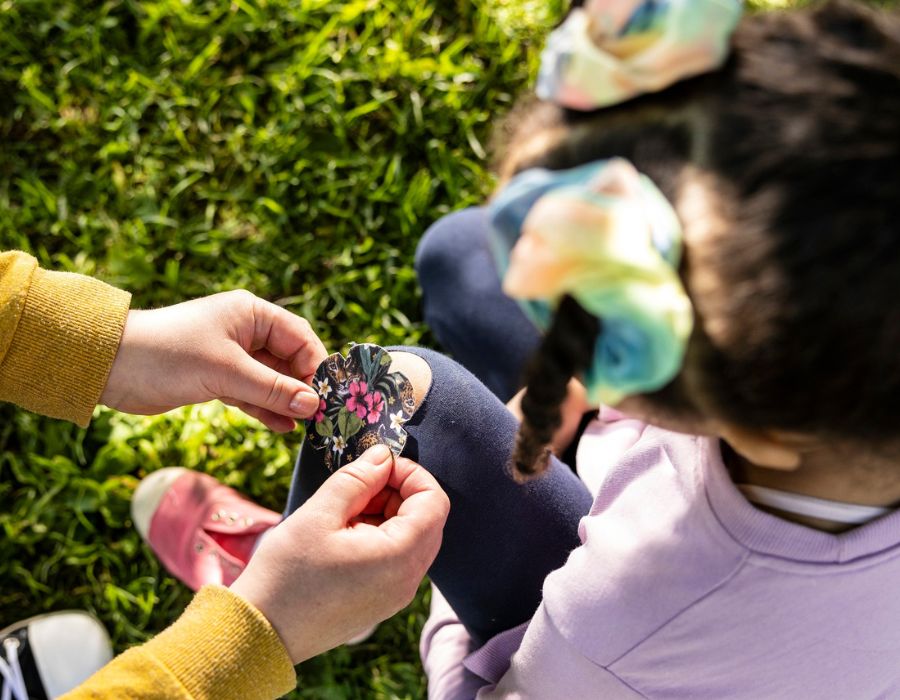
With FabPatch™ patches, you can repair, cover, and decorate a wide variety of items.
Please note that FabPatch™ is not a personal protective equipment (PPE) and should not be used to repair protective gear.
Does it really work? Can you promise anything?
FabPatch™ definitely helps extend the lifespan of your clothes — often significantly, and at least to some extent. And as 7-year-old Urho said: “This is a patch that makes the clothes cooler!”
That much we can promise!
FabPatch™ adheres well to all kinds of textiles. You can easily patch a hole in just one minute by rubbing it on as instructed — we can promise that, too!
The wash durability depends on the fabric material, its age, how the patch is applied, where it’s placed, and how soon it’s washed afterward. Our best-tested patches have now lasted over 4 years in heavy use and frequent washing.
Since there are so many variables in textiles, we can’t give an exact promise about wash durability. We do know that 100% cotton can be a bit more challenging than other materials — but even there, experiences vary widely.
P.S. The dryer actually helps with adhesion. And, of course, following the instructions is key!
Our complaint rate is only 0.08%, and every FabPatch™ product comes with a satisfaction guarantee.
Why doesn’t FabPatch™ stay on?
There can be a few possible reasons:
1. Chemicals
FabPatch™ is designed to last through many washes when used correctly. However, chemicals used in some fabrics can affect how well it adheres. We’ve chosen not to add more chemicals to our product to counteract this — keeping FabPatch™ as clean and eco-friendly as possible.
2. Too light pressing during application
For FabPatch™ to hold firmly, it needs to be rubbed on with strong pressure for at least one minute — preferably a few minutes. You can use, for example, the back of a spoon to help. If you wish, you can also enhance the bond by ironing for up to 10 seconds, following the garment’s care instructions.
3. Too short bonding time before washing
FabPatch™ needs about three days to fully adhere before the first wash. You can use the patched garment right away, but strong stretching or soaking during the first three days may weaken the bond. The longer FabPatch™ has to set before washing — and also between washes — the better it will hold.
4. Fabric coatings and different materials
Some fabrics have dirt- or water-repellent coatings that may also repel FabPatch™. For this reason, we don’t generally recommend applying it to coated textiles, even though in some cases it still adheres well.
100% cotton can be more challenging than other materials, so pay special attention to pressing the patch on firmly. Ironing helps improve wash durability, especially with cotton fabrics. FabPatch™ tends to hold best on synthetic materials or cotton blends that contain at least a small amount of synthetic fiber.
If your FabPatch™ comes off after the first few washes and none of the reasons above seem to apply, please contact us at info@fabpatch.com.
We are continuously developing the product and we listen carefully to all user experiences.
Where is FabPatch™ made?
FabPatch™ is made in Finland.
What is FabPatch’s role in the circular economy?
FabPatch™ was born from the idea that existing clothes and gear are worth repairing and keeping in use for as long as possible. With an easy-to-apply repair patch, the life of a damaged textile item can be extended without sewing or ironing.
The circular economy is at the core of what we do. We want to make repairing easy and inspiring and promote a culture where damage does not automatically mean that a product has reached the end of its useful life.
As part of our sustainability work, we also examine the impacts of our own operations and continuously develop our materials, manufacturing processes, packaging, and ways of working. We openly communicate our goals, the work we have done, and areas for further development in our annual Sustainability Report.
Read more about our Sustainability work.
What materials are FabPatch™ patches made of?
The adhesive used in FabPatch™ repair patches has been specifically developed for textile repair and is designed to withstand regular use and wear. The adhesive manufacturing process is solvent-free.
The adhesive complies with the EU REACH and CLP regulations and contains no animal-derived materials (not intentionally added).
The recycled polyester material used in our STRETCH collection is certified according to the Global Recycled Standard (GRS).
The fabrics used in the production of our STRETCH, EXTREME, SHOE and REFLECTIVE products are OEKO-TEX® STANDARD 100 certified.
The MERINO wool yarn used in our production is OEKO-TEX® STANDARD 100 certified. The production process is also mulesing-free.
How should FabPatch™ be disposed of?
FabPatch™ patches do not interfere with textile recycling. If the patched textile is not suitable for reuse, dispose of it as textile waste. And don’t forget to recycle the packaging too!
Can I get FabPatch™ patches in other colors or patterns?
Our collection is constantly evolving, and we always follow the principles of sustainability in our sourcing. We also collaborate with brands, and our products can be customized to suit different needs.
How have FabPatch™ patches been tested?
FabPatch™ patches have been tested with consumers at different stages of product development since 2018. Our first testers included one hundred families, and over the years, the products have been tested by hundreds of users in different applications and in different countries. In addition to families, the testers have included, for example, hikers, athletes, and barefoot shoe users. We have also tested products together with our brand partners before launching them.
During the testing, we have collected feedback on, among other things, ease of application, adhesion, wash resistance, the functionality of different sizes and shapes, and material properties. Consumers have also participated in developing ideas for and commenting on patterns and themes.
Feedback received from testing, brand partners, and users is an important part of our continuous product development. With the help of this feedback, we have developed our existing products as well as new solutions for different repair applications.